Wits Researchers Develop New Wound Care Approach
Wits Researchers Develop New Wound Care Approach
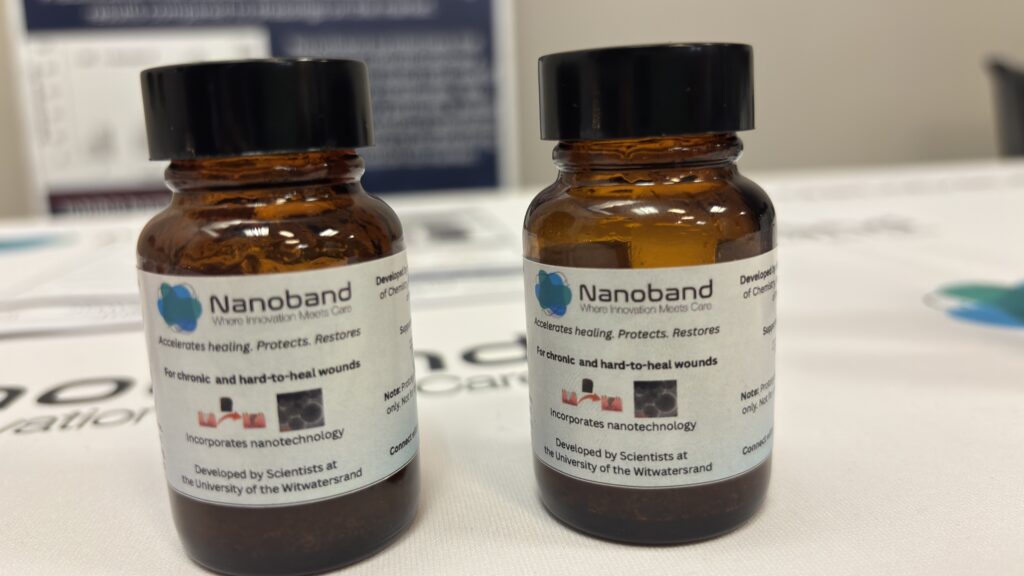
Chronic wounds are a growing healthcare challenge worldwide, often leading to prolonged recovery, repeated hospital visits, infections and, in severe cases, amputations. A research team at the University of the Witwatersrand is developing a potential new solution: NanoBand™. This is a wound dressing designed not just to cover wounds, but to actively support the healing process.
Unlike traditional dressings, NanoBand™ is built around a three-dimensional nanostructured scaffold that interacts with the wound environment, helping tissue repair while reducing bacterial activity. The innovation was recently presented during the Wits pitching session at SWEAT Africa, where it sparked conversations with investors, entrepreneurs, and ecosystem builders about its potential path to market.
For the researchers behind NanoBand™ – including Dr Siyabonga Sipho Nkabinde, Thapelo Mofokeng, Dr Ndivhuwo Shumbula, Dr Pumza Mente, Dr Zakhele Ndala, and Prof Nosipho Moloto – the project began with a very personal motivation. “There is a high prevalence of chronic illnesses in our country, many of which predispose patients to developing chronic wounds such as diabetic foot ulcers,” says Dr Mente – one of the scientists behind NanoBand™.
“We have personally witnessed our grandparents, relatives, and members of our communities suffer amputations and prolonged complications due to poorly managed wounds,” adds Dr Mente, explaining that those experiences shaped the team’s decision to focus on developing a solution tailored to the realities of the African healthcare system. “This deeply motivated us to develop a local solution that could serve our population across the entire value chain – from creating employment opportunities through local manufacturing to delivering accessible, affordable healthcare solutions.”
Local production is also strategically important for health systems resilience. “Importantly, local production reduces dependence on global supply chains, which can be disrupted, as we saw during the COVID-19 pandemic in 2020,” says Dr Mente.
The scientific approach behind NanoBand™ is what makes it different from conventional dressings. Many wound treatments rely on flat materials placed on top of the wound surface. But chronic wounds are rarely simple or shallow. “Chronic wounds are often complex and can extend deep into tissue layers,” Dr Mente explains. “Many conventional dressings, particularly those containing active ingredients, rely on surface-level contact with the wound bed.”
NanoBand™ instead uses a flexible three-dimensional structure that can adapt to the wound itself. “A 3D nanostructured scaffold is fundamentally different because it can conform to irregular and deep wound geometries, ensuring contact across the entire wound surface,” she says.
This deeper interaction with tissue is designed to support the healing process more effectively. “It enhances interaction with the tissue, supports cell regeneration, and improves infection management,” Dr Mente explains. “NanoBand™ is flexible and can be custom-fitted into the wound cavity, whereas a traditional 2D dressing is placed on top of the wound and cannot fully adapt to its shape, thereby limiting effective contact and therapeutic performance.”
Another major advantage of the technology is its potential to reduce reliance on antibiotics – a key issue in the global fight against antimicrobial resistance. “Antibiotics are effective in managing bacterial infections; however, their prolonged and repeated use contributes to antimicrobial resistance,” says Dr Mente.
NanoBand™ addresses infection in a different way. “It incorporates antimicrobial nanoparticles that provide localised infection control without relying on conventional antibiotics.”
Because the mechanism is not antibiotic-based, it helps avoid one of the key drivers of antimicrobial resistance. “It reduces the risk of driving antibiotic resistance while still effectively managing bacterial load and supporting tissue regeneration,” she explains.
Presenting NanoBand™ at SWEAT Africa also helped the team think differently about the innovation’s path beyond the lab. “The event reinforced the importance of de-risking NanoBand™ to position us strategically for partnerships and investment,” Dr Mente says. “It encouraged us to think more deliberately about our commercialisation pathway, funding structure, and value proposition to investors.”
One particular piece of feedback from investors proved especially influential. “One of the most impactful pieces of feedback related to our financial ask,” she says. “Instead of seeking funding only to complete the next development phase, we were advised to ask for enough capital to reach first revenue and to structure this funding ask around milestone-based disbursements.”
For the team, that advice could significantly shape how they pursue funding going forward. “This approach reduces the time and uncertainty associated with repeated funding applications, which can be lengthy and unpredictable,” Dr Mente explains. “It was a perspective we had not previously considered and will significantly influence our funding strategy going forward.”
The unconventional format of SWEAT Africa – which combines discussions with outdoor activities – also helped foster more meaningful engagement. “The outdoor, activity-based format created natural networking opportunities,” says Dr Mente. “Engaging in shared activities made it easier to connect with people organically. It was far easier to approach individuals in this informal setting than in a traditional conference environment.”
“The format fostered meaningful dialogue and laid the foundation for potential long-term partnerships and collaborations,” she adds.
The NanoBand™ team is now focused on the next stage of development: generating the data needed for regulatory submission and clinical trials. “We have received support from the Technology Innovation Agency (TIA) and the University of the Witwatersrand,” Dr Mente says. “Our key milestones over the next 12–18 months focus on risk reduction through completion of the external validation phase.”
This process will produce standardised safety, performance and reproducibility data needed to move toward clinical testing. “Successfully achieving these milestones will position us for commercialisation and strategic partnerships,” she explains.
For researchers trying to translate scientific breakthroughs into real-world impact, the journey can be complex. For the NanoBand™ team, navigating the funding landscape has been one of the steepest learning curves. “The most challenging aspect has been accessing appropriate funding, partly due to our initial limited understanding of the venture capital ecosystem within South Africa,” Dr Mente says.
But experiences like SWEAT Africa are helping to close that gap. “Participating in SWEAT Africa was particularly valuable because it exposed us to the broader innovation and investment landscape in South Africa,” she says. “It helped us better understand how to position NanoBand™ for access to investments and funding.”
If successful, NanoBand™ could represent more than a new medical product. It could demonstrate how locally driven research and innovation ecosystems in Africa are beginning to translate cutting-edge science into solutions for some of the continent’s most pressing health challenges.