
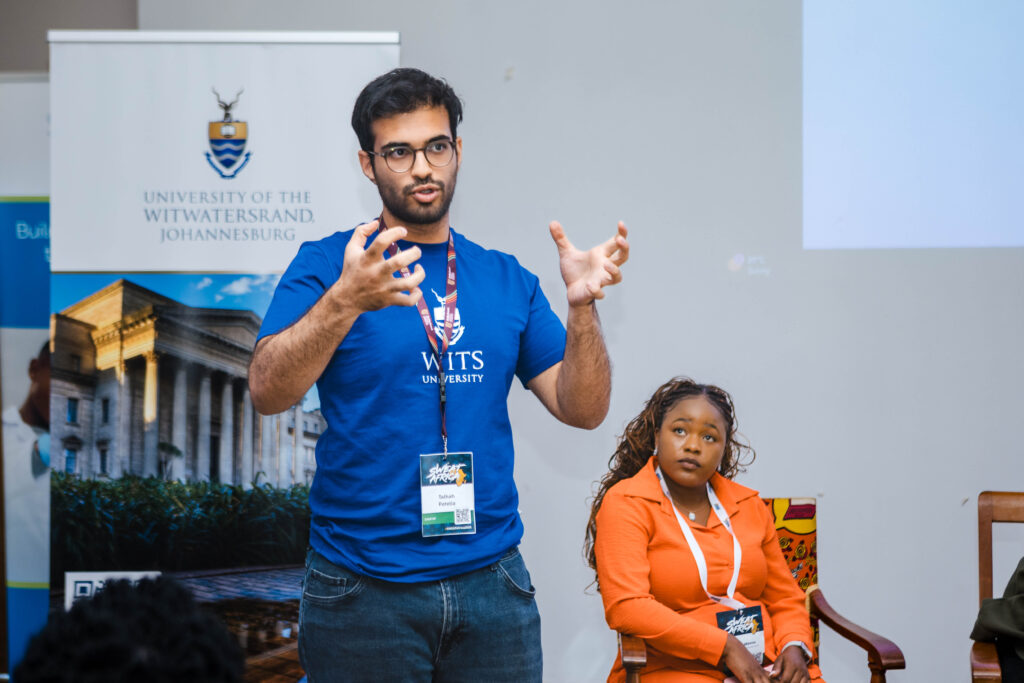
At SWEAT Africa 2026, the Wits Innovation Centre hosted a side event that brought nine student-led startups into direct conversation with investors and collaborators. Designed to give founders real exposure, the session created space to pitch, test ideas, and explore partnerships. Five startups – KoldData, NanoBand, HRA Transportation, Nutrix, and Gotcha Education – delivered formal pitches, while the other four – Trichome Biotechnologies, STEM Scholars, The Obvious Choice, and Rezerva – joined discussions and networking.
Led by Tebogo Machete, head of the Innovation Support Office at Wits, the initiative aimed to strengthen the link between university innovation and market opportunity. Investor engagement was strong, with rigorous questioning pushing founders to refine their models and sharpen their value propositions. “We wanted to give our students an opportunity to pitch to the many investors and VCs here, and also connect with collaborators,” Machete said. “The questions were crucial – helping founders remove their own bias and see what still needs to be strengthened.”
SWEAT Africa’s open, informal format further enabled these interactions. “It was easier to approach people and start conversations,” Machete noted. “Without the constraints of conference rooms, mobility and reach improved significantly.”
The event also underscored the broader role universities can play in advancing Africa’s innovation ecosystem. Collaboration between institutions, investors, and founders accelerates the journey from research to real-world application. “Collaborations open opportunities for skills and idea exchange,” Machete said. “They speed up development and commercialisation, while opening markets that might otherwise remain inaccessible.”
Katlego Chogole, Business Development Officer at Wits Commercial Enterprise, highlighted the importance of such platforms for early-stage innovators. “Events like SWEAT allow founders to test their thinking in real time,” she said. “Engaging beyond their immediate circles often accelerates how ideas evolve into viable ventures.”
For founders, the experience offered both validation and challenge, requiring them to defend their ideas against questions on scalability, markets, and strategy.
Among the startups was KoldData, founded by Wisdom Mokasi, which is developing an AI-powered ecosystem to safeguard cold chains in Sub-Saharan Africa. Its platform, KoldData.ai, integrates with a smart AIoT cooler, KoldSentry, capable of stabilising temperatures for over 80 hours without electricity. “For me, SWEAT Africa was truly transformative,” Mokasi said. “It’s the first hard-tech focused conference I’ve encountered in South Africa where investors and founders connected as humans first. The conversations went beyond capital to building long-term partnerships for resilient infrastructure.”
Science-driven startup, Trichome Biotechnologies, founded by Dr Marushka Soobben and Chanel Willemse, translates advanced protein research into practical nutrition and scientific solutions while strengthening research capacity through academic partnerships.
Dr Soobben also leads STEM Scholars, an initiative introducing high school learners to science and entrepreneurship, helping them connect academic knowledge to real-world innovation.
Nutrition startup The Obvious Choice is developing all-in-one daily supplement solutions to simplify complex routines into a single, accessible product.
Healthcare innovation was represented by NanoBand, which is developing advanced wound-care solutions. The team gained valuable insight into the biotech funding landscape. “We now better understand the types of venture capital available and how to position ourselves,” they said.
HRA Transportation, founded by Navhani Tshikosi, offers logistics services tailored to university communities. “The investor engagement challenged us to think beyond organic growth toward structured expansion,” Tshikosi said.
Rezerva, founded by Mohamed Omar, is streamlining car wash bookings and payments through a mobile platform. “The discussions helped clarify the difference between a traditional business and a scalable startup,” Omar said, noting the importance of focusing on a niche before expanding.
Gotcha Education, founded by Talhah Patelia, addresses connectivity challenges in African education with an offline-first EdTech platform that enables learning and assessments during outages. The startup has already secured early traction, including a R100 000 win at the Allan Gray Orbis Foundation Jamboree and its first R70 000 contract. “My pitch focused on the reality that many African students are expected to learn on always-on systems,” Patelia said. “Gotcha ensures continuity when connectivity fails.” He added that investor feedback strengthened their positioning, revenue model, and scalability strategy.
Nutrix, founded by Alimerinda Mlambo, connects university students with campus food vendors and student delivery runners. “Being among founders, investors, and researchers building from an African base made the continent’s potential tangible,” Mlambo said. “Some of the most valuable exchanges happened in informal moments.”
For Wits, the event reinforced the importance of creating more opportunities for student entrepreneurs to engage in real-world environments. “We want to grow the community of student entrepreneurs being supported,” Machete said. “Beyond events like SWEAT, we are intensifying support to help innovations move closer to market.”